

Product Description
Product Type and Specification
1.Classification by structure
type | Features | Application |
Double-sided | Both upper and lower loads can be carried, and the structure is stable. | Heavy machinery, three-dimensional storage |
Single-sided type | Only one side is a flat, lightweight design. | Conventional cargo turnover, production line transportation |
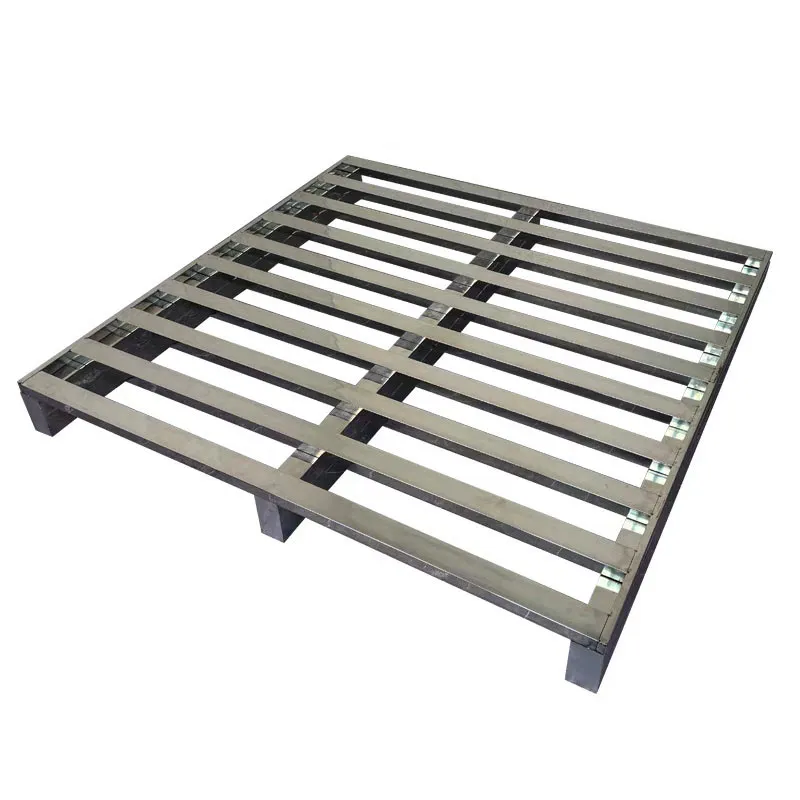
Grid Type | Hollow design, drainage, and ventilation | Cold chain, humid environment |
Folding type | Foldable for storage, saving space | Temporary warehousing, logistics recovery |
2. Classification by material
Carbon Steel Pallet | Economical and practical, it requires surface anti-rust treatment (spraying/galvanizing) |
Stainless steel Pallet | Acid and alkali-resistant, suitable for industries with high hygiene standards such as food and medicine. |
Aluminum Alloy Pallet | Lightweight, suitable for transporting precision equipment such as aviation and electronics. |
3.Customization options
size | Adjustable length, width and height (standard 1200×1000mm, or designed according to shelf/vehicle size) |
Surface treatment | Anti-slip pattern, rubber pad, conductive coating (anti-static requirement) |
Additional Features | RFID tag slot, lifting hole, removable fence, etc. |
Product Features

Product Application
Heavy industry
Cold chain logistics
Automated warehousing
Export transportation
Special environment

Product application

Product package

Our stock
Yes. Jinzehong offers custom metal pallet sizes and structural configurations for different industrial storage and handling requirements. Buyers can provide their required length, width, height, load capacity, and forklift entry specifications to discuss a suitable pallet design.
Stainless steel pallets can be suitable for food processing environments where corrosion resistance and frequent cleaning are important. Jinzehong offers stainless steel material options, including grades 201 and 304. Buyers should confirm the required surface finish, cleaning procedures, and applicable hygiene standards before ordering.
Custom metal pallets may be designed for automated warehouses, conveyor systems, and compatible material handling equipment. Buyers should provide equipment drawings, dimensional tolerances, load requirements, and operating conditions to confirm compatibility before production.
Common surface protection options for iron and carbon steel pallets include galvanizing and protective coatings. The appropriate treatment depends on humidity, exposure conditions, handling frequency, and corrosion resistance requirements. Jinzehong can discuss suitable surface finishes according to the intended application.
To request a quotation from Jinzehong, provide the required pallet dimensions, material preference, maximum static and dynamic loads, forklift entry configuration, surface treatment, and estimated order quantity. Technical drawings or product photographs can also help clarify special requirements.
Buyers should confirm material specifications, pallet dimensions, welding quality, surface treatment, and agreed load requirements before bulk production. Inspection criteria and any necessary load-testing arrangements should be discussed with Jinzehong in advance.
Choosing between a stainless steel pallet and a galvanized iron pallet depends on the operating environment, corrosion resistance requirements, cleaning procedures, and overall procurement budget. Both materials can provide reliable support for industrial storage and transportation when the pallet is properly designed for its intended load.
Stainless steel pallets are commonly considered for food processing, pharmaceutical packaging, clean manufacturing, and other environments where moisture resistance and frequent cleaning are important. Grade 304 stainless steel generally provides better corrosion resistance than grade 201, particularly in more demanding conditions. However, the appropriate grade should always be selected according to the actual operating environment and cleaning chemicals.
A galvanized steel pallet uses a protective zinc coating to help reduce corrosion of the underlying carbon steel. This makes it a practical option for general warehousing, machinery handling, industrial distribution, and applications where a balance between durability and cost is important.
For warehouses handling heavy products in relatively dry environments, an iron pallet with suitable surface protection may offer a more economical solution. Stainless steel becomes more attractive when cleaning frequency, humidity, or exposure conditions justify the additional material cost.
Jinzehong offers customizable metal pallet solutions with iron, galvanized iron, and stainless steel material options. Buyers can select appropriate materials, dimensions, and structural configurations according to their storage and transportation requirements.
Before ordering, consider the expected service life, environmental exposure, maintenance requirements, and loading conditions to determine which pallet material provides the best long-term value.
The load capacity of a heavy-duty metal pallet depends on its steel grade, material thickness, reinforcement structure, dimensions, and method of support. Unlike lightweight disposable packaging, industrial metal pallets can be engineered for repeated handling of machinery components, construction materials, metal products, and other heavy goods.
When evaluating a steel pallet load capacity, buyers should distinguish between three loading conditions.
Static load capacity refers to the weight a pallet can support while stationary on a suitable surface. Dynamic load capacity describes its performance during movement by forklifts or other handling equipment. Racking load capacity applies when the pallet is supported by warehouse rack beams rather than a continuous floor surface.
These ratings are not interchangeable. A pallet capable of supporting a heavy static load may require additional reinforcement for forklift transportation or elevated racking applications.
Jinzehong's metal pallet product range includes configurations with published static load capacities of approximately 1–10 tons and dynamic capacities of 0.5–3 tons, depending on the design. Actual ratings must be confirmed for the selected configuration and loading conditions.
Load distribution is equally important. Uniformly distributed cartons place different stresses on a pallet than concentrated machinery components of the same total weight.
For custom industrial applications, Jinzehong can discuss structural configurations based on pallet dimensions, intended loading methods, and material preferences.
Buyers should provide their maximum load weight, product footprint, handling equipment, and storage conditions when requesting a quotation. These details help establish suitable technical specifications and avoid unnecessary material costs.
Selecting the right warehouse metal pallets requires careful consideration of forklift compatibility, warehouse racking systems, load distribution, and available storage space. A pallet that fits the product dimensions may still create operational problems if its entry clearances or support structure do not match the handling equipment.
For forklift applications, entry direction is one of the first specifications to confirm. Two-way entry pallets allow forklift access from two opposing directions, while four-way entry designs can offer greater flexibility in busy warehouses where loading and unloading occur from different sides.
However, the actual compatibility of a metal pallet for forklift use depends on fork spacing, entry height, pallet base geometry, and equipment specifications.
Warehouse racking creates additional requirements. Pallets supported by rack beams experience different structural stresses than pallets resting on a flat floor. Buyers should verify rack beam spacing, support orientation, load distribution, and any necessary reinforcement before using pallets in elevated storage.
In automated warehouses, consistent dimensions and structural tolerances are particularly important. Pallets used with conveyors, automated guided vehicles, or robotic handling systems must match the mechanical requirements of those systems.
Jinzehong supplies custom metal pallet configurations for different industrial storage and material handling applications, including adjustable dimensions and forklift entry arrangements.
For accurate customization, buyers should provide warehouse layout information, forklift specifications, rack dimensions, and maximum loading requirements.
Properly specified industrial steel pallets can improve handling consistency, support efficient warehouse operations, and reduce compatibility problems between pallets and existing equipment.
The metal pallet price depends on several manufacturing and technical factors, including raw material selection, pallet dimensions, load capacity, structural complexity, surface treatment, and order quantity. For industrial procurement teams, understanding these variables is essential when comparing quotations from different suppliers.
Material selection is one of the most significant cost factors. Carbon steel and galvanized iron pallets are generally economical choices for conventional industrial storage, while stainless steel pallets typically require a higher initial investment because of their material costs.
Pallet construction also affects pricing. A standard iron pallet designed for uniformly distributed loads may require less reinforcement than a heavy duty metal pallet supporting concentrated machinery components. Additional steel profiles, welded joints, customized forklift openings, and specialized surface treatments can increase production costs.
Order volume may influence unit pricing because fabrication setup and manufacturing expenses can be distributed across larger quantities.
However, purchase price alone does not determine the most economical solution. Buyers should also evaluate maintenance requirements, replacement frequency, expected service life, transportation weight, and pallet reuse cycles.
For example, a durable metal pallet used repeatedly in a closed-loop logistics system may provide better long-term value than a lower-cost alternative requiring frequent replacement.
Jinzehong offers custom metal pallets with different material options, structural designs, and surface finishes to accommodate industrial procurement requirements.
To receive a meaningful quotation, buyers should specify pallet dimensions, required load capacity, material grade, surface treatment, and estimated purchasing quantity.
Comparing steel pallet costs against consistent technical specifications helps buyers identify suitable solutions without compromising operational requirements.
Finding a reliable metal pallet manufacturer in China requires evaluating more than product pricing. Industrial buyers should consider material availability, customization capabilities, manufacturing quality, technical communication, and the supplier's ability to understand specific warehouse and transportation requirements.
Unlike standardized packaging products, custom metal pallets often require adjustments to dimensions, reinforcement structures, forklift entry configurations, and surface treatments. These specifications must match the customer's products, handling equipment, and operating environment.
When selecting a metal pallet supplier, buyers should request detailed product specifications, material information, and drawings where necessary. For heavy-duty applications, load ratings should be supported by appropriate engineering assessment or testing documentation.
Jinzehong, located in Anping County, Hebei Province, China, supplies customizable iron and steel pallet products for industrial storage and logistics applications.
Its product range includes iron, galvanized iron, and stainless steel material options, with customizable dimensions and structural configurations. A commonly referenced pallet dimension is 1200 × 1000 mm, while alternative sizes can be discussed according to project requirements.
These options make it possible for buyers to specify pallets for machinery handling, warehouse storage, industrial distribution, and other material handling applications.
International purchasers should confirm technical drawings, manufacturing specifications, inspection arrangements, packaging methods, and commercial terms before placing orders.
Whether sourcing heavy duty steel pallets, stainless steel pallets, or custom iron pallets, providing complete application details helps the manufacturer recommend an appropriate solution.
Contact Jinzehong with your pallet dimensions, loading requirements, preferred materials, and purchasing quantity to discuss a customized metal pallet quotation.
Choosing between a metal pallet and a wooden pallet depends on the intended application, handling frequency, storage environment, and long-term operating costs. Both options are widely used in industrial logistics, but their structural characteristics and maintenance requirements differ significantly.
Wooden pallets are commonly selected for lightweight shipments, one-way transportation, and applications where initial purchase cost is a major consideration. However, repeated handling, moisture exposure, and heavy concentrated loads may increase the likelihood of damage and replacement.
An iron pallet or steel pallet provides a rigid structure suitable for demanding industrial handling environments. Properly designed metal pallets can support heavy products, resist damage from repeated use, and maintain consistent dimensions throughout their service life.
Metal pallets also eliminate concerns associated with wood splinters and wood-boring pests. Unlike regulated solid-wood packaging, all-metal pallets are not subject to ISPM 15 wood-treatment requirements.
However, metal pallets generally have higher initial costs and may add transportation weight. Their economic advantages are therefore most apparent in reusable logistics systems where durability and repeated handling are important.
For businesses operating closed-loop warehouse systems, industrial steel pallets can help reduce replacement frequency and support consistent material handling procedures.
Jinzehong provides customizable metal pallet solutions for industrial storage and transportation, including different materials, dimensions, and load-bearing configurations.
Buyers should compare the total cost of ownership, expected reuse cycles, handling conditions, and product weight before choosing between metal and wooden pallets.
For repeated heavy-duty industrial applications, a properly specified metal pallet may provide better long-term operational value.
Durable Coating And Reinforced Structure For Iron Pallets

We offer full customization of iron metal pallets to fit your exact warehouse or transport requirements. From pallet size, grid design, load capacity, to surface finishing, every element is tailored. You can choose from galvanized, spray-coated, or hot-dip treated surfaces for added durability. Whether you require 2-way or 4-way forklift entry, collapsible models, or stackable options, we can deliver according to your specifications. Send us your design or simply describe your usage needs—our engineers will create a professional solution supported by detailed 3D CAD drawings and sample confirmations.

Our custom size iron metal pallets are built with safety, strength, and efficiency in mind. Made from high-grade steel and processed through precision welding and surface treatments, each pallet ensures secure handling of goods under high loads. All designs comply with industrial logistics standards and undergo load testing and anti-rust certification. Whether you’re moving large machinery, automotive parts, or stacked containers, our pallets provide reliable support while preventing damage or collapse during storage and transit. For manufacturers, distributors, and logistics hubs alike—safe transport starts with the right pallet.
Hit enter to search or ESC to close