17 Jun 2026
Target industries: Chemical processing / Pharmaceutical manufacturing / Food & beverage / Water treatment / Petrochemical
Product type: Plain weave stainless steel wire mesh (304 / 316 / 316L grades)
Industrial filtration demands filter media that balance precision, durability, and operational efficiency. Plain weave stainless steel wire mesh has been a trusted solution across chemical plants, pharmaceutical facilities, and food processing lines for decades. Its simple over-under weave pattern creates uniform square openings, delivering consistent particle retention while maintaining high flow rates and easy cleanability. Our plain weave 304/316 stainless steel mesh is manufactured to ASTM and ISO standards, offering a cost-effective, reusable filtration solution for a wide range of separation applications.

Application scene: Plain weave stainless steel mesh as filter media in industrial filtration systems – chemical, pharmaceutical, and food processing.
What Is Plain Weave Stainless Steel Wire Mesh?
Plain weave is the most fundamental and widely used wire mesh weave pattern. Each warp wire passes alternately over and under each weft (shute) wire, creating a stable, uniform square opening structure. This simple construction delivers several performance advantages:
Uniform mesh openings – Consistent particle retention across the entire screen area
High open area – Maximizes flow rate while maintaining filtration precision
Structural stability – The weave resists distortion under normal operating pressures
Cost-effective – Simple manufacturing process offers excellent value for volume applications
Easy to clean – Smooth surface allows backwashing and chemical cleaning for reuse
Plain weave mesh is available in 304, 316, and 316L stainless steel grades, offering corrosion resistance suitable for acidic, alkaline, and high-temperature environments. Mesh counts range from coarse (10 mesh) to fine (500 mesh), with corresponding micron ratings from approximately 2,000µm down to 25µm.

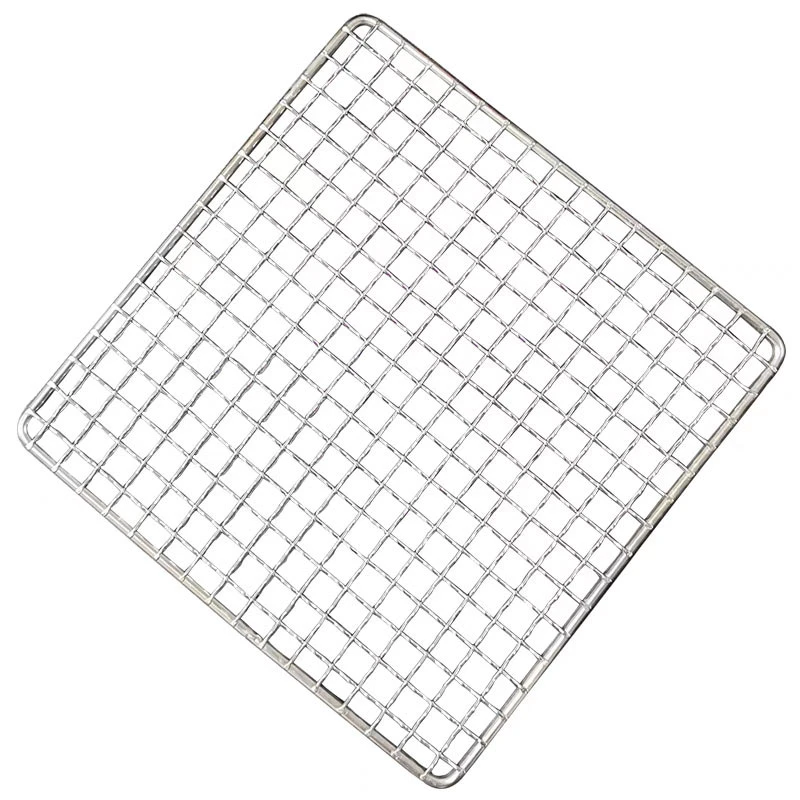
Product close-up: Plain weave stainless steel mesh – uniform square openings with consistent wire crossing pattern.
What Problems Does Plain Weave Mesh Solve in Filtration?
1. Inconsistent Particle Retention & Product Quality Risks
The issue: In chemical synthesis, pharmaceutical API production, or food processing, inconsistent filter media can allow oversized particles to pass through, contaminating final products, causing batch rejections, and increasing manufacturing costs.
Our solution: Our plain weave stainless steel mesh is woven under strict quality control to ensure uniform mesh openings with minimal tolerance variation. Each roll is inspected for consistency in mesh count, wire diameter, and open area. This precision ensures that every section of the screen delivers the same particle retention performance – batch after batch.
Result: Consistent product quality, reduced rejection rates, and reliable compliance with industry quality standards (GMP, ISO, HACCP).
2. Corrosion & Contamination from Harsh Process Fluids
The issue: Many industrial filtration applications involve aggressive chemicals (acids, alkalis, solvents), high-temperature liquids, or salt-laden environments. Standard polymer or lower-grade metal mesh degrades rapidly, shedding particles into the product stream or failing prematurely.
Our solution: We offer three stainless steel grades optimized for different corrosive environments:
304 stainless steel – Excellent resistance to organic chemicals, mild acids, and food-grade applications. Suitable for general industrial filtration.
316 stainless steel – Contains molybdenum for enhanced resistance to chlorides, saline solutions, and stronger acids. Ideal for marine environments, chemical processing, and pharmaceutical applications.
316L stainless steel – Low-carbon version of 316, providing maximum corrosion resistance in welded assemblies and high-temperature sterilization cycles.
The woven structure itself is non-shedding – no fibers or particles break away from the media, eliminating a common contamination source found in polymer or fabric filters.
Result: Long filter service life, zero media-shedding contamination, and compliance with sanitary design requirements in food and pharma production.
3. High Maintenance Costs from Disposable Filters
The issue: Disposable filter cartridges and bags require frequent replacement, generating ongoing consumable costs and production downtime. In continuous processes, each filter change interrupts operations and creates waste disposal burdens.
Our solution: Plain weave stainless steel mesh is fully cleanable and reusable. After reaching differential pressure limits, the mesh can be cleaned via backwashing, ultrasonic cleaning, or chemical soaking, restoring filtration performance. A single stainless steel mesh screen can last for years in many applications, significantly reducing total cost of ownership (TCO).
Result: Lower operating costs, reduced waste, less downtime, and a faster return on investment compared to disposable filter alternatives.
Plain Weave vs. Dutch Weave: When to Choose Which?
Understanding the difference between plain weave and Dutch weave is critical for proper filter selection. A good rule of thumb is to consider plain weave if you value cost-effectiveness, higher flow rates, or larger pore openings; choose Dutch weave if you need finer filtration performance, improved strength, or optimal durability in demanding applications[reference:0].
Comparison Factor | Plain Weave | Dutch Weave |
Weave pattern | One wire over, one wire under – uniform square openings | Warp wires thicker than weft wires – dense, slitlike openings |
Filtration precision | Standard – mesh count determines micron rating | Higher – can achieve finer ratings for given wire diameter |
Flow rate (open area) | Higher – more open area, lower pressure drop | Lower – denser weave restricts flow |
Strength & durability | Good for most industrial applications | Higher – withstands greater differential pressure |
Cleanability | Excellent – smooth surface, easy backwashing | More difficult – retained particles trapped in dense structure |
Cost | Lower – simpler manufacturing | Higher – more complex weaving |
Best for | General filtration, highflow screening, cleanable applications | Fine filtration, highpressure, particleretentive duties |
For most chemical, pharmaceutical, and food filtration applications requiring good flow with periodic cleaning, plain weave provides the optimal balance of performance and economy. For absolute rated filtration below 25 microns, Dutch weave or multi-layer sintered mesh may be recommended.
Technical Specifications & Industry Compliance
Material grades: 304, 304L, 316, 316L stainless steel – also available in 430, 904L, or duplex alloys upon request
Weave type: Plain weave (square openings)
Mesh range: 10 mesh to 500 mesh – custom meshes available
Wire diameter: 0.025mm – 1.2mm, matched to mesh count for optimal open area
Micron rating (nominal): 25µm (500 mesh) to 2,000µm (10 mesh) – see conversion chart below
Open area: 30% – 70% depending on mesh count and wire diameter
Width options: Custom widths up to 2,000mm
Standard compliance:
ASTM E2016 – Standard specification for industrial woven wire cloth[reference:1]
ISO 9044 – Industrial woven wire cloth
FDA compliant – Suitable for food contact applications (304/316 grades)
GMP compliant – Suitable for pharmaceutical manufacturing
Custom fabrication: Filter discs, sheets, rolls, pleated cartridges, and custom-shaped elements – send your drawing for quote

Application gallery: Plain weave mesh in chemical, pharmaceutical, food, and water treatment filtration.
Mesh Count to Micron Conversion Reference Table
The table below provides approximate micron ratings for standard plain weave stainless steel mesh. The exact micron rating depends on wire diameter and weave type – contact us for precise specifications for your application[reference:2].
Mesh Count (per inch) | Approx. Micron Rating | Opening (mm) | Typical Application |
20 mesh | 840 µm | 0.84 mm | Coarse filtration, gravel separation, water intake screening |
60 mesh | 250 µm | 0.25 mm | Food & beverage pre-filtration, industrial liquid straining |
100 mesh | 150 µm | 0.15 mm | Paint and powder screening, general chemical filtration |
200 mesh | 75 µm | 0.075 mm | Fine liquid filtration, edible oil polishing |
325 mesh | 44 µm | 0.044 mm | Chemical processing, laboratory separations, pharmaceutical sieving |
500 mesh | 25 µm | 0.025 mm | Fuel filtration, hydraulic systems, high-precision liquid filtration |
Key Selection Factors for Plain Weave Mesh
When selecting plain weave stainless steel mesh for your filtration application, consider these four interconnected variables[reference:3]:
Mesh count – Higher mesh count provides finer filtration but reduces open area and flow rate. Balancing mesh count with throughput requirements is essential.
Wire diameter – Thicker wires offer greater mechanical strength and abrasion resistance but reduce open area. Thinner wires increase open area but may compromise structural integrity under pressure.
Open area – A higher open area improves flow rate and reduces pressure drop, but may reduce filtration precision. Optimizing open area ensures adequate flow while still capturing target contaminants.
Material grade – 304 is suitable for most mild environments; 316/316L is recommended for chloride exposure, acidic conditions, and pharmaceutical/food applications requiring maximum corrosion resistance.
Customization Options (Order by Drawing or Photo)
We understand that every filtration system has unique requirements. We offer full customization on plain weave stainless steel mesh:
Mesh count: From 10 to 500 mesh – any specification
Wire diameter: Custom diameters to achieve desired open area and strength
Width and length: Roll lengths up to 30 meters, custom widths
Material grade: 304, 316, 316L, 430, 904L, duplex alloys
Fabricated forms: Filter discs (any diameter), pleated cartridges, filter bags, baskets, strainers, and customshaped elements
Edge finishing: Raw cut, welded perimeter, bound edges, or reinforced rings
Send us your specifications or process requirements – we will recommend the optimal mesh count, wire diameter, and grade for your filtration needs, with a free quotation within 24 hours.


Custom fabrication: Filter discs, sheets, pleated cartridges, and custom elements available from plain weave mesh.
Frequently Asked Questions (FAQ)
What is the difference between 304 and 316 plain weave stainless steel mesh for filtration?
304 stainless steel offers good corrosion resistance for most chemical, food, and water applications. 316 contains molybdenum, providing enhanced resistance to chlorides, saline solutions, acids, and marine environments. For pharmaceutical manufacturing and highpurity applications, 316L (lowcarbon) is recommended to prevent sensitization during welding and sterilization.
What micron rating can plain weave mesh achieve?
Plain weave mesh typically ranges from approximately 2,000 microns (10 mesh) down to 25 microns (500 mesh). For finer filtration below 25 microns, we recommend Dutch weave or multilayer sintered mesh. Contact us with your target particle size for a specific recommendation.
Can plain weave mesh be cleaned and reused?
Yes. One of the key advantages of stainless steel wire mesh over disposable filters is its cleanability. Backwashing, ultrasonic cleaning, or chemical soaking can remove captured particles and restore filtration performance. A wellmaintained stainless steel mesh screen can last for years, significantly reducing operating costs.
Is plain weave mesh suitable for hightemperature filtration?
Yes. 304 and 316 stainless steel maintain mechanical strength at elevated temperatures. Continuous service temperature limits are approximately 870°C (1,600°F) for 304 and 870°C as well for 316 – though the actual limit depends on specific conditions. For the most demanding hightemperature applications, we can supply heatresistant alloys such as Inconel or Hastelloy.
What is the typical lead time for plain weave mesh orders?
For standard mesh counts (20-400 mesh) in 304 or 316 grades, lead time is typically 10-15 days. Custom meshes, rare alloys, or large fabrication projects may require 20-30 days. Contact us with your requirements for an accurate delivery estimate.
Do you provide sample pieces for testing?
Yes. We can provide small sample pieces (200mm × 200mm or custom size) for your testing and validation before full production orders. Contact us to request a sample.
What documentation do you provide for pharmaceutical applications?
For pharmaceutical and food applications, we can provide material certificates (EN 10204 3.1), FDA compliance statements, particle retention test reports, and lot traceability documentation for full regulatory compliance.
Ready to Optimize Your Filtration Process?
Contact us with your target particle size, fluid/process conditions, required flow rate, and preferred material grade. We will reply with a recommended specification, technical datasheet, and free quotation.
Email: ada@jinzehongwiremesh.com
WhatsApp: +86 15383785666
Request a sample or specification review: Send your process parameters for a free filtration media recommendation.
Disclaimer: The application scenario described above is based on typical industrial filtration requirements across chemical, pharmaceutical, food, and water treatment industries. It represents our product capabilities, not a specific client reference. Product images are for illustration only. Custom specifications available upon request.
Hit enter to search or ESC to close


